The Center for Accountability and Rule of Law, Sierra Leone (CARL-SL) has carefully followed recent developments regarding the appointment of an “Acting Mayor” for the Freetown City Council, arising in the context of the absence from office of the elected Mayor, Yvonne Aki-Sawyerr, and her Deputy. These events have generated significant public discourse and raised important questions regarding the proper interpretation of the legal framework governing local councils in Sierra Leone.
At the heart of the matter lies an issue of statutory interpretation under the Local Government Act, 2022. Specifically, the current circumstances present a gap or ambiguity as to how mayoral functions are to be exercised in a situation where both the Mayor and Deputy Mayor are simultaneously absent from office. In the absence of explicit statutory provisions addressing this precise scenario, differing positions have emerged, contributing to legal uncertainty and public concern.
In this regard, we observe that where such uncertainty exists, it is imperative that all actions taken by political or administrative actors remain within the confines of the law. Any measure adopted outside clear statutory authority risks undermining the rule of law and eroding public confidence in democratic institutions. It is therefore essential that this matter be approached with caution, restraint, and a firm commitment to legality. In a constitutional democracy such as Sierra Leone, the court remains the ultimate arbiter of legal disputes and questions of interpretation. Issues concerning the scope of authority of public offices, and the legality of actions taken in their absence fall squarely within judicial competence. Resort to the court is not merely an option but the most appropriate and legitimate pathway to resolving such institutional ambiguities.
In light of the foregoing, we respectfully advance the following recommendations:
• All relevant stakeholders, such as the governing party, main opposition party, and the Freetown City Council, should promptly seek judicial interpretation through appropriate legal proceedings
. • Pending such judicial determination, all parties should refrain from taking further unilateral actions that may deepen the legal uncertainty or create competing claims to authority.
• The relevant institutions of local governance should ensure continuity of essential administrative functions through lawful internal mechanisms, without attempting to exercise powers not clearly granted by law.
• Supporters of the governing party and the main opposition party, and members of the public are urged to remain calm, peaceful, and law-abiding, and to allow due process to take its course without resort to confrontation or disorder.
CARL-SL emphasizes that the peaceful and lawful resolution of this matter is critical not only to the smooth running of the Freetown City Council, but also to the preservation of democratic governance and the rule of law in Sierra Leone. At this moment, restraint, respect for institutions, and fidelity to legal processes are of utmost importance.
Furthermore, we remain committed to promoting accountability, constitutionalism, and the rule of law, and will continue to monitor developments closely.
For further enquiry, please contact Mr. Jeremy Ben Simbo, Acting Executive Director, CARL-SL on: +232-76-672841 or simbojb@carl.org.sl / simbojeremy@yahoo.com THE END!
This simplified version—developed by the Centre for Accountability and Rule of Law (CARL) with UNDP support—breaks down complex legal provisions into clear, accessible language for all Sierra Leoneans.
The Centre for Accountability and Rule of Law, Sierra Leone (CARL-SL) warmly welcomes the official commencement of the Criminal Procedure Act (CPA) 2024, which takes effect today, September 16th, 2025. This landmark piece of legislation marks a historic step forward in modernizing Sierra Leone’s justice system, replacing the outdated 1965 Act.
We acknowledge the tremendous effort invested in bringing this reform to fruition and commend all stakeholders who have worked towards strengthening fairness, efficiency, and transparency within our criminal justice system.
As we celebrate this progress, CARL-SL emphasizes the importance of accountability in its implementation. We call on all justice sector actors to ensure that the law is applied in ways that uphold its spirit and purpose, leaving no gaps that could undermine access to justice.
CARL-SL reaffirms its commitment to closely monitoring the implementation of the CPA 2024, as we have consistently done with other justice reforms, and to constructively engaging stakeholders towards building a justice system that truly serves all Sierra Leoneans.
Together, let us work to ensure that this reform delivers meaningful change in the lives of our people
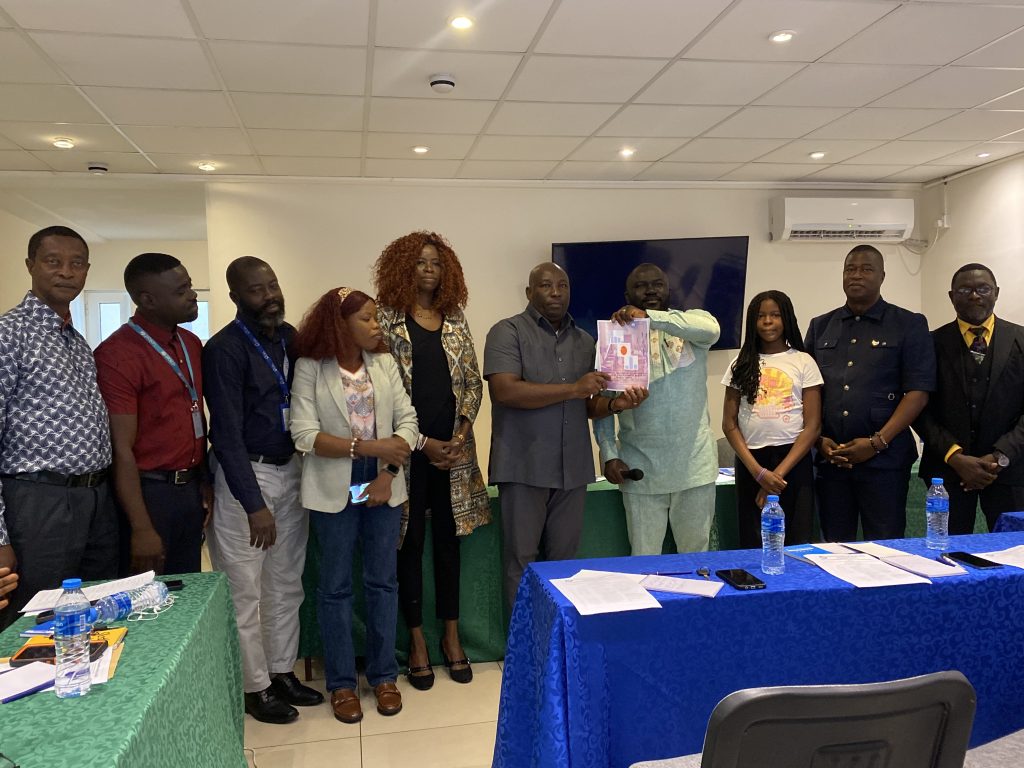
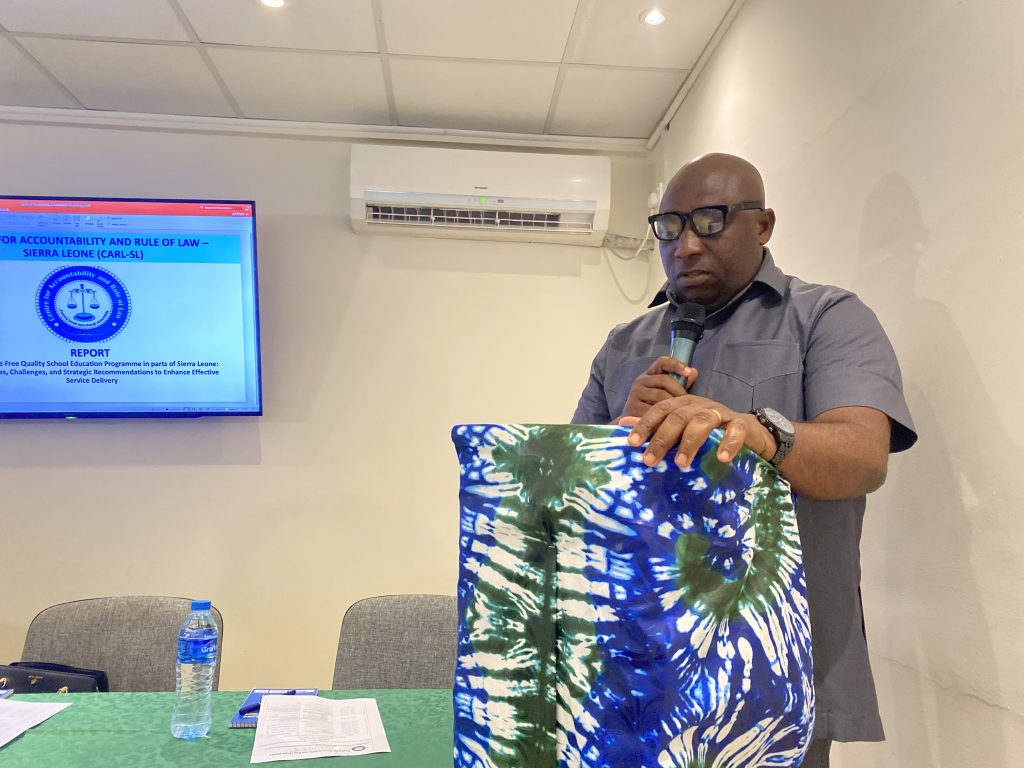
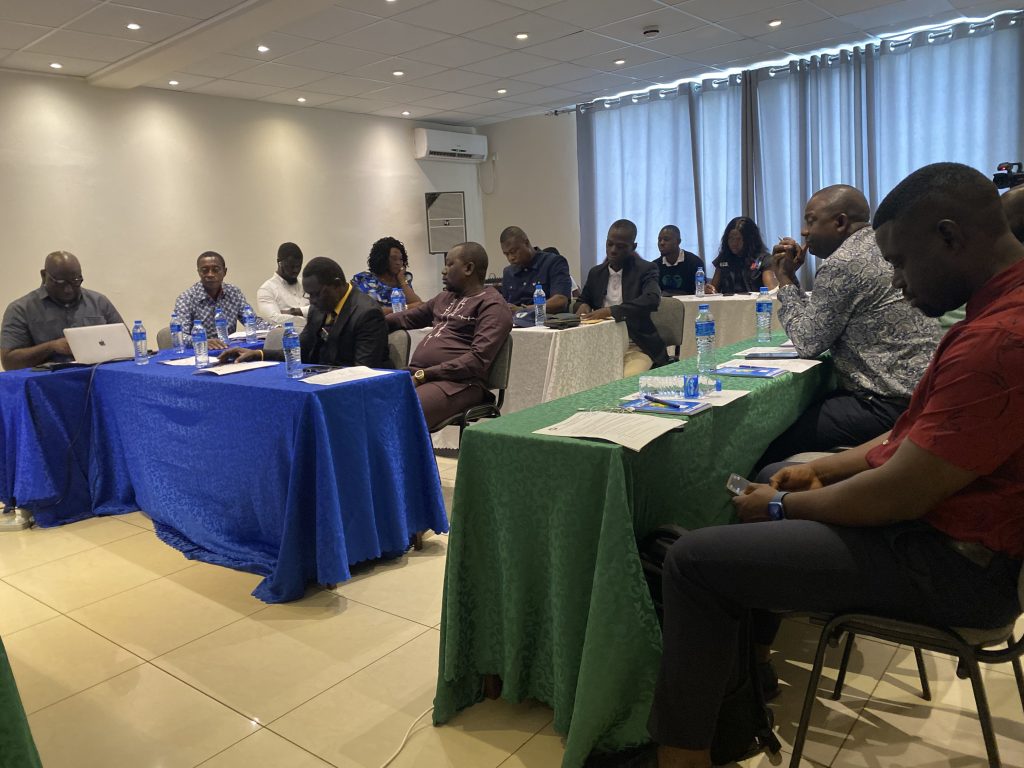
The Centre for Accountability and Rule of Law – Sierra Leone (CARL-SL) has presented the findings of its thorough assessment of the Free Quality School Education (FQSE) Programme today, Thursday, August 28th. The event, held at the New Brookfields Hotel, gathered key government officials, development partners, civil society representatives, educators, and members of the media.
This study, fully funded by CARL-SL, aimed to evaluate the effectiveness of the FQSE initiative and identify areas for improvement.
While recognizing the government’s significant efforts to ensure that every child has access to quality education, the findings are anticipated to guide future strategies and initiatives, fostering a more accountable and transparent educational framework.
Jeremy Ben Simbo, head of programmes at CARL-SL, has urged development partners to work alongside the government and civil society to address challenges, ensuring that every Leone spent on education yields real benefits for children and their communities.
The Centre for Accountability and Rule of Law, Sierra Leone(CARL) is gravely concerned by a recent memorandumauthored by the Teaching Service Commission (TSC) andreleased by the Ministry of Finance indicating that the Government of Sierra Leone has been disbursing huge sums of money to four thousand six hundred and sixty-two (4,662) ghost workers across the country, resulting in the loss of significant sums of public funds.
The memorandum, dated 24th July, 2025 and addressed to various banking institutions, states that the “ghost workers”were discovered after a physical verification exercise conducted by the TSC this year. It further requests the various banks listed in the memorandum to “furnish the Ministry of Finance with comprehensive information relating to the status of the accounts” of the teachers listed in the memorandum as well as withdrawals for the period January through June, 2025.
We commend the TSC for its ongoing efforts to ensure accountability in the delivery of public services, especially as it relates to the payment of salaries. We sincerely hope that the Ministry of Finance will ensure that these names are deleted from the payroll and all funds fully recovered.
“The presence of “ghost workers” in the public service payroll has gone on for several years,” said Jeremy Ben Simbo, CARL’s Head of Programmes, adding that “it may have been part of a criminal scheme to siphon public funds into the pockets of individuals across the relevant ministries and departments”
Public officials have over the years used different methods to defraud the state of funds needed to provide basic services.
“It wasn’t a mistake,” Mr. Ben Simbo said, adding that “it looks like a plain criminal enterprise designed, planned andimplemented by key actors across the ministries, agencies and school administrators concerned”.
Whilst CARL commends the ongoing efforts by the Ministry of Finance to recover the funds, we urge the Anti-Corruption Commission to spare no efforts in ensuring not just a full recovery of the said sums but also a thorough investigation of the circumstances leading to the disbursement of those funds and where there is credible evidence of criminal intent, those responsible should be brought to justice.
We further demand that the Ministry of Basic and Senior Secondary School Education and the Ministry of Finance make a clear statement on this unfortunate and unacceptable development by not only suspending those suspected to have participated in this criminal scheme, but by also withholding the salaries and any benefits due them until the investigation is concluded.
There is no doubt that corruption constitutes a binding constraintto Sierra Leone’s development efforts, and unless state actors who conspire to undermine the delivery of basic social and economic services through corruption are held accountable, the economic and social development aspirations of the people of Sierra Leone will never be achieved. At a time when the country is struggling to satisfy its domestic and foreign debt obligations as well as provide basic social and economic services to the people of Sierra Leone, we should leave no stones unturned to bring to justice those who defraud the Government and people of Sierra Leone.
For further clarification, please feel free to contact Mr. Jeremy Ben Simbo, Head of Programmes, CARL-SL on: +232 76-672841 or email: simbojeremy@yahoo.com